
Water Damage Restoration San Diego
Water damage rarely affects only the place where the water first appears.
A broken pipe inside a wall can eventually damage drywall, insulation, framing, flooring, paint and electrical components. Roof intrusion may begin above the ceiling before traveling through insulation and structural materials into walls and rooms below. Flooding across a commercial floor can reach offices, equipment, electrical systems, HVAC components and neighboring tenant spaces.
That is why water damage restoration in San Diego should consider the entire building.
Homes and businesses are interconnected systems. Roofing protects the interior. Windows and doors form part of the exterior envelope. Plumbing travels through walls and ceilings. Electrical wiring shares many of those same cavities. HVAC systems extend throughout the property. Flooring, drywall, paint and cabinetry cover structural components that may remain wet even after visible water disappears.
Successful restoration starts by determining where the water came from, where it traveled and everything it affected along the way.
Water Damage Can Affect Every Part of a Property
Indoor water does not respect construction boundaries.
It moves beneath floors.
Moisture can wick upward through drywall.
Water enters cabinets and wall cavities.
Gravity carries it between floors.
Leaks above ceilings can travel along pipes, framing and mechanical systems before becoming visible somewhere else.
Consequently, the room containing standing water may represent only one part of the loss.
A complete assessment should consider adjoining rooms and the building systems connected to the damaged area.
For larger residential and commercial losses, that can mean evaluating the property from the roof and exterior envelope all the way down to flooring and structural components.
Plumbing & Pipe Water Damage
Plumbing failures are among the most common causes of indoor water damage.
Supply lines, fittings, water heaters, toilets, sinks, refrigerators, dishwashers, washing machines and other plumbing-connected equipment can release water unexpectedly.
Small leaks create their own problems.
A slow leak behind a wall may continue unnoticed for weeks. By the time staining or odors become apparent, moisture may already have affected drywall, insulation, framing and cabinetry.
Burst pipes create a different situation.
Large volumes of water can spread across several rooms quickly and travel through openings into lower floors.
Stopping the plumbing source is the first priority.
Understanding where the released water went becomes the next.
Flooring & Subfloor Water Damage
Floors often receive the greatest initial exposure during an indoor flood.
Carpet can absorb substantial moisture.
Wood flooring may swell, cup or distort.
Laminate materials can deteriorate.
Water can migrate underneath vinyl, tile and other finished flooring where the problem becomes considerably harder to see.
The subfloor matters too.
Plywood, OSB, concrete and underlayment materials react differently after exposure.
Removing standing water from the surface does not automatically mean the floor assembly underneath is dry.
Before new flooring is installed, the substrate should be considered as part of the restoration.
Otherwise, a brand-new floor can conceal an old moisture problem.
Drywall, Walls & Insulation
Walls contain far more than the surface we paint.
Inside them may be structural framing, insulation, electrical wiring, plumbing and other building components.
Drywall can absorb moisture from below after flooding. Water entering higher in the wall can travel downward inside the cavity without immediately becoming visible.
Insulation can also retain moisture.
Depending on the conditions, selective removal may be necessary to gain access to affected materials and allow appropriate drying.
Not every wall needs to be demolished after a water loss.
The objective should be identifying what is actually affected, removing materials that cannot reasonably remain and preserving unaffected portions whenever practical.
Structural Framing
Water reaching the structure itself deserves careful attention.
Wall studs, floor joists, roof framing and other wood components can absorb moisture.
That does not automatically mean framing needs replacement.
Exposure time, material condition and drying potential all influence what happens next.
The important point is accessibility.
Reconstruction should not conceal framing that still requires drying or evaluation.
Once new drywall, flooring and finishes are installed, accessing those materials again becomes considerably more disruptive.
Ceiling Water Damage
Ceiling stains often provide evidence of a problem occurring somewhere above.
An upstairs bathroom can leak into a downstairs ceiling.
Roof water can travel through an attic before becoming visible.
HVAC equipment or drain problems may produce water around mechanical areas.
Commercial buildings introduce suspended ceilings containing lighting, electrical wiring, pipes, ductwork and other infrastructure.
Visible ceiling damage should therefore trigger a broader question:
What is happening above it?
Replacing ceiling material without identifying the source only repairs the symptom.
Roof Leaks & Interior Water Damage
Roof problems can become interior restoration projects surprisingly quickly.
Once rainwater passes through the exterior roofing system, it can reach roof decking, insulation and structural framing.
From there, gravity determines where it travels.
Ceilings may become stained or saturated. Water can enter wall cavities. Paint may blister. Flooring and furniture can eventually be affected.
The visible interior damage may not sit directly beneath the roof failure.
Water can travel along framing and other building components before finally appearing inside.
Interior restoration and roof repair therefore need to work together.
Reconstructing the inside without correcting the exterior entry point leaves the property vulnerable to another loss.
Windows, Glass & Exterior Openings
Windows and glass systems are another potential route for water intrusion.
Moisture appearing around a window does not necessarily mean the glass itself failed.
Flashing, seals, exterior finishes, frames and surrounding construction can all influence how water enters.
Once moisture penetrates the opening, surrounding drywall, insulation, framing, paint and flooring may become affected.
Commercial properties introduce larger systems.
Storefront glass, aluminum entrances, window walls and other glazing assemblies can allow water intrusion to affect interior finishes even when the glass remains intact.
Restoration should identify the actual path of entry before damaged interiors are rebuilt.
Paint & Interior Finishes
Paint often shows the symptoms of water damage before the underlying problem becomes obvious.
Bubbling, peeling, staining and discoloration can indicate moisture behind the finished surface.
Simply painting over a stain is not water damage restoration.
The underlying material should first be evaluated.
Once the source has been corrected and affected materials have been appropriately dried or replaced, paint becomes part of the final reconstruction.
Trim, baseboards, decorative wall treatments and other finishes may require similar attention.
The finished surface should be the final step—not a cover for unresolved damage.
Cabinets, Kitchens & Bathrooms
Kitchens and bathrooms contain several water-dependent systems within relatively small areas.
A leaking sink can affect cabinetry and flooring.
Dishwasher failures may release water underneath cabinets before spreading into adjoining rooms.
Toilet or shower problems can involve flooring, walls and rooms below.
Built-in cabinetry creates another challenge because water can become trapped underneath or behind it.
Visible cabinet faces may look relatively normal while moisture remains in areas that cannot easily be seen.
Larger losses can turn a simple plumbing repair into a kitchen or bathroom reconstruction project involving cabinets, flooring, drywall, paint, plumbing and electrical work.
Electrical Systems After Water Damage
Water and electrical infrastructure require particular caution.
Outlets, switches, lighting, wiring, panels and electrical equipment may become involved depending on the location and severity of the loss.
Property owners should not assume a component is safe simply because standing water has disappeared.
Qualified professionals may need to evaluate affected electrical infrastructure.
Commercial buildings can involve significantly more complicated systems.
Power distribution, emergency lighting, access control, security equipment, data infrastructure and specialized machinery may all require consideration.
Electrical safety needs to be addressed before cosmetic reconstruction takes priority.
HVAC & Mechanical Systems
Heating, ventilation and air-conditioning systems extend throughout a building.
Ductwork may pass through water-damaged ceilings and walls.
Mechanical equipment can be located in closets, attics, mechanical rooms or other areas affected by leaks.
Condensate drainage can sometimes be the source of the water problem itself.
Large commercial HVAC systems introduce additional considerations.
Multiple zones, rooftop equipment, mechanical rooms and extensive duct distribution can intersect with affected areas throughout a building.
When water reaches mechanical components or surrounding materials, those conditions should be evaluated before walls and ceilings are closed during reconstruction.
Doors, Trim & Finish Carpentry
Interior doors and trim can also be affected by flooding.
Wood products may absorb moisture and swell.
Door frames can become distorted.
Baseboards frequently show damage along flooded walls.
Exterior doors introduce additional concerns because they are part of the building envelope.
Water entering around a door can affect flooring, wall framing and finishes surrounding the opening.
During reconstruction, these components should be evaluated individually rather than automatically retained or discarded.
Different Types of Water Damage
The source of the water influences the restoration strategy.
Clean water generally begins from a relatively sanitary source such as certain supply-line failures.
Gray water can contain contaminants and requires additional precautions.
Black water presents more serious contamination concerns and can include sewage and certain types of outside floodwater.
Conditions can also change over time.
Water moving through flooring, waste, soil and building materials can become increasingly contaminated.
Determining the source and conditions of the loss helps establish what can potentially be dried and what may require removal.
Hidden Water Damage
Some of the most important water damage cannot be seen from the center of the room.
Moisture can remain:
- Beneath flooring
- Behind baseboards
- Inside wall cavities
- Behind cabinets
- Above ceilings
- Within insulation
- Around windows and doors
- Beneath plumbing fixtures
- Near HVAC equipment
- Inside adjoining rooms
That is why the boundary of a water loss should not automatically be defined by visible staining.
Finding hidden moisture can change the entire restoration plan.
Water Extraction
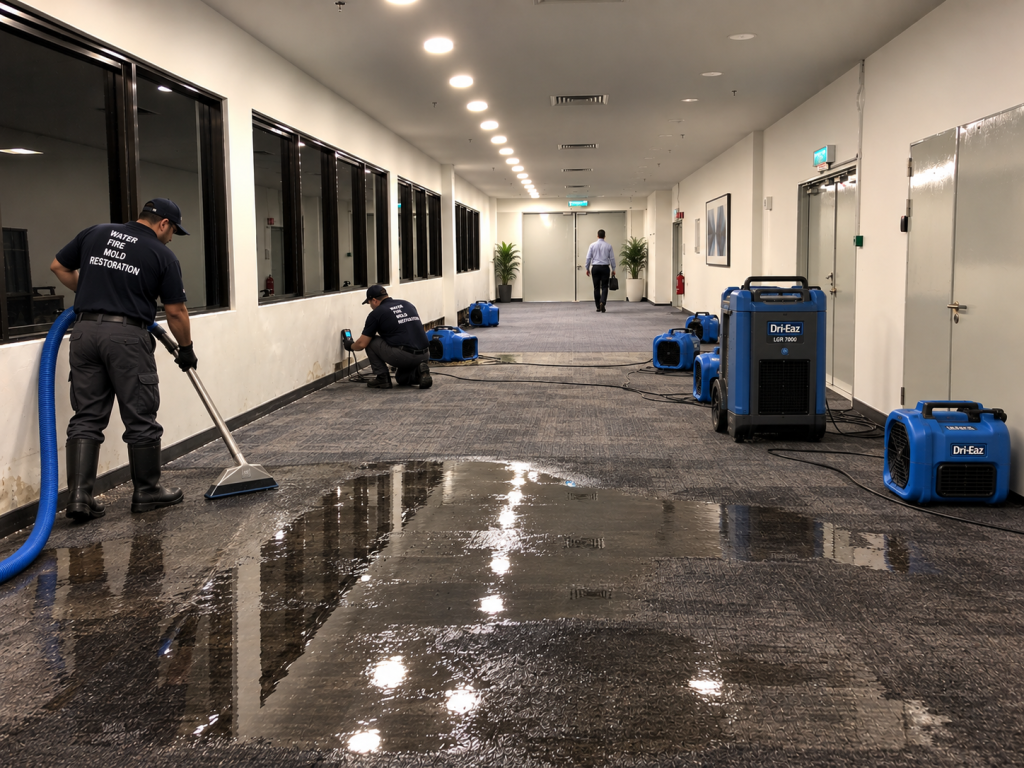
Removing standing water is one of the first major restoration steps.
Extraction reduces the amount of water available to continue spreading through the property.
Large losses may require substantial water removal before detailed drying begins.
However, extraction is not the same as structural drying.
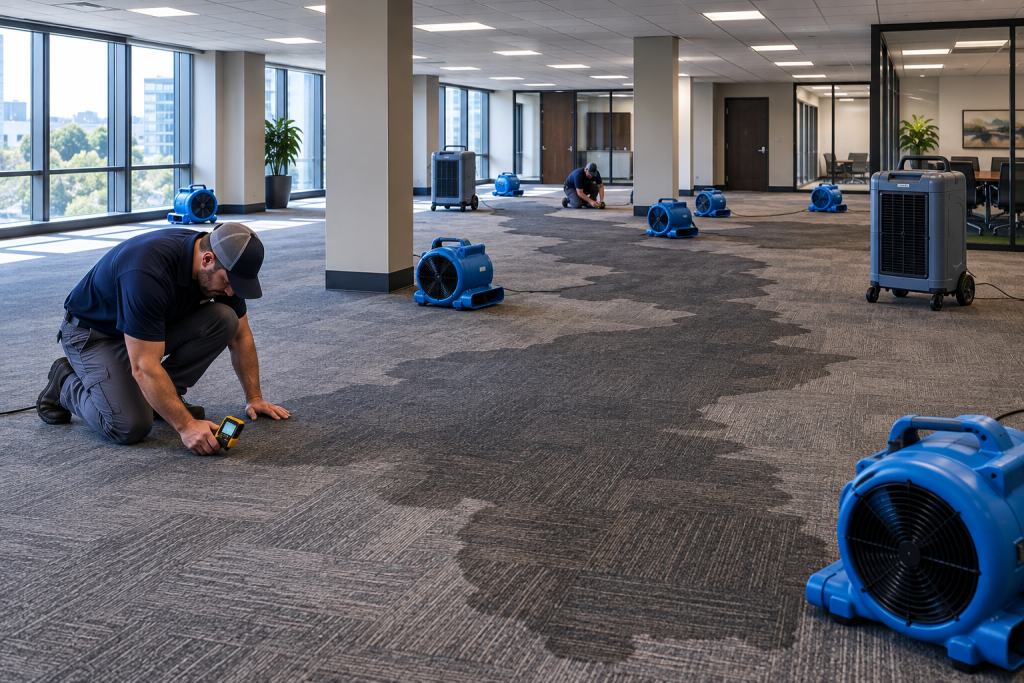
A room can look dramatically better after standing water disappears while building materials remain wet.
Restoration must continue beyond what can be seen on the surface.
Structural Drying & Dehumidification
Drying addresses moisture remaining inside affected building materials and the surrounding environment.
Different materials respond differently.
Drywall does not behave like concrete.
Wood framing dries differently than carpet.
An enclosed wall cavity presents different conditions from an open floor.
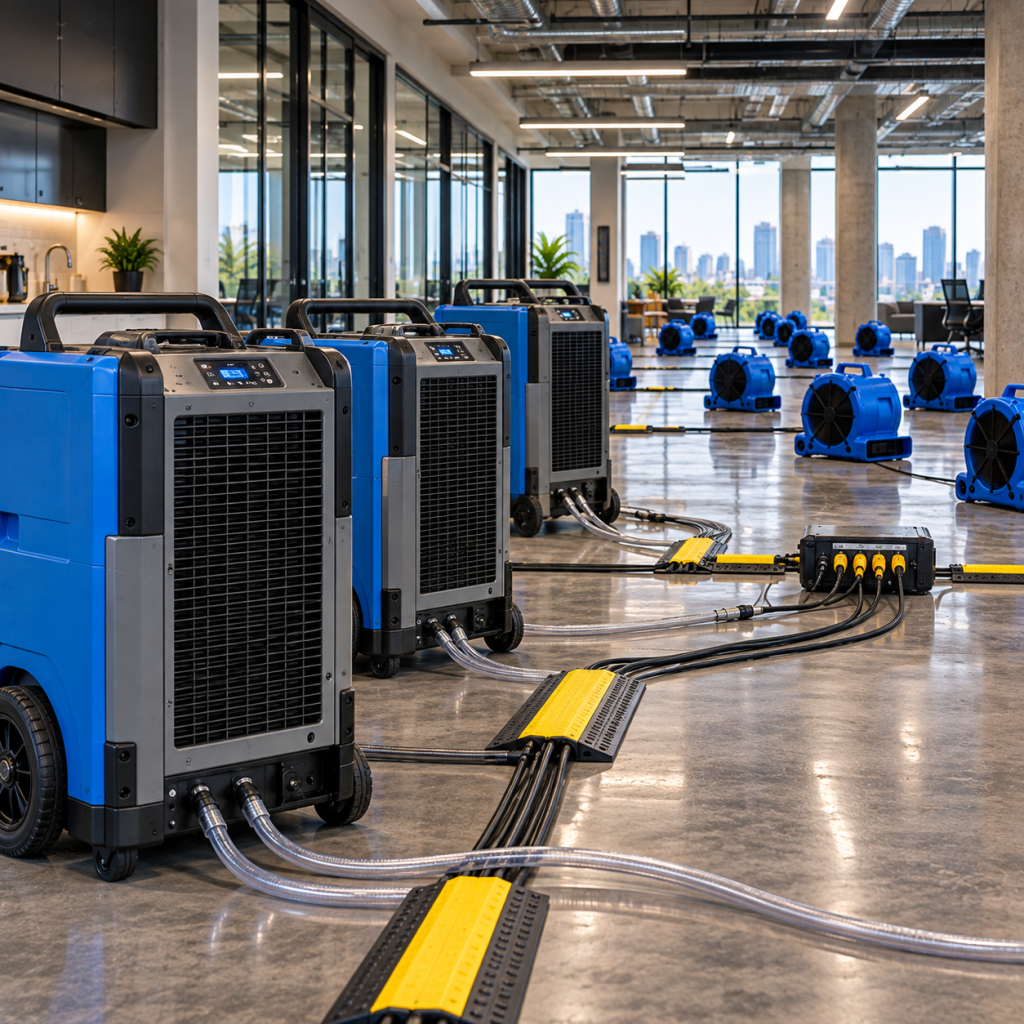
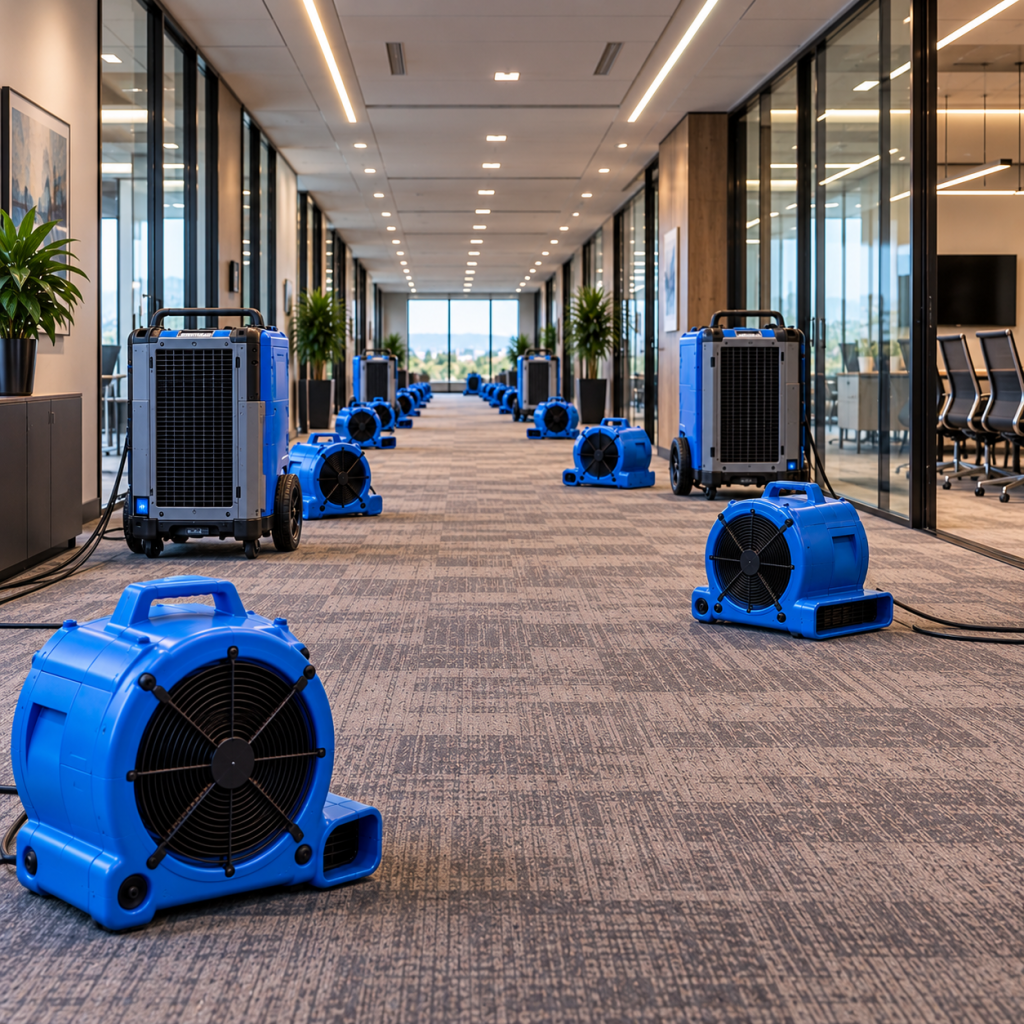
Air movement and dehumidification can be used as part of the drying strategy depending on the conditions found at the property.
Monitoring progress helps determine whether materials are responding appropriately and whether additional access or removal is necessary.
Residential Water Damage Restoration
A home is a network of connected spaces and systems.
Water beginning in an upstairs bathroom can eventually affect the bedroom flooring, hallway, walls and ceiling downstairs.
Kitchen flooding may involve cabinets, appliances, electrical connections and adjoining living areas.
Roof intrusion can extend from the attic into insulation, ceilings and walls.
Restoration should therefore look beyond individual rooms.
The objective is to understand how the entire home was affected before reconstruction begins.
Commercial Water Damage Restoration in San Diego
Commercial water damage creates a larger set of concerns.
The property itself needs restoration, but the business inside it may also need to continue operating.
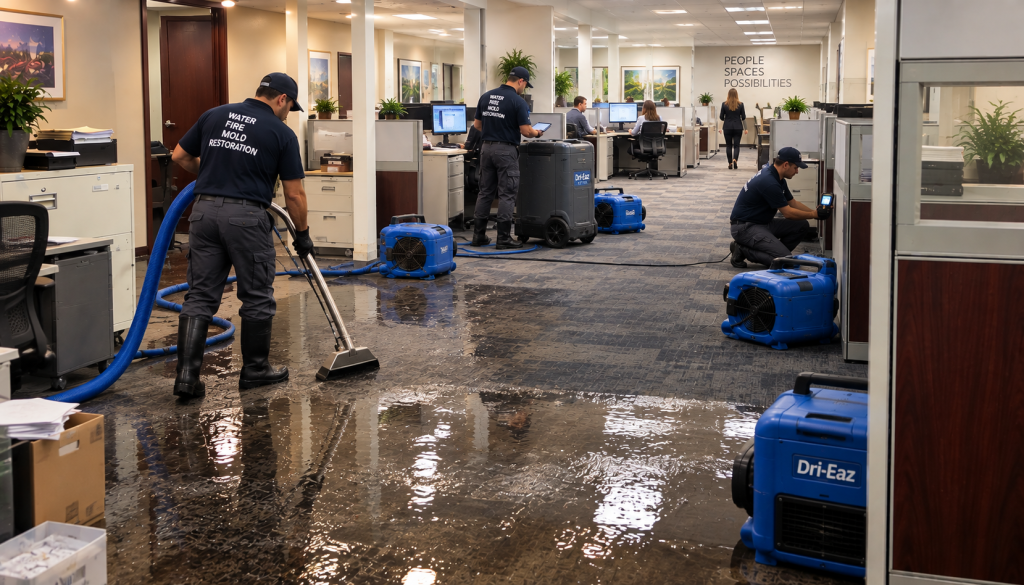
Office buildings can have multiple affected tenant spaces.
Retail stores may need to protect merchandise and customer areas.
Restaurants combine plumbing, electrical, HVAC and specialized equipment.
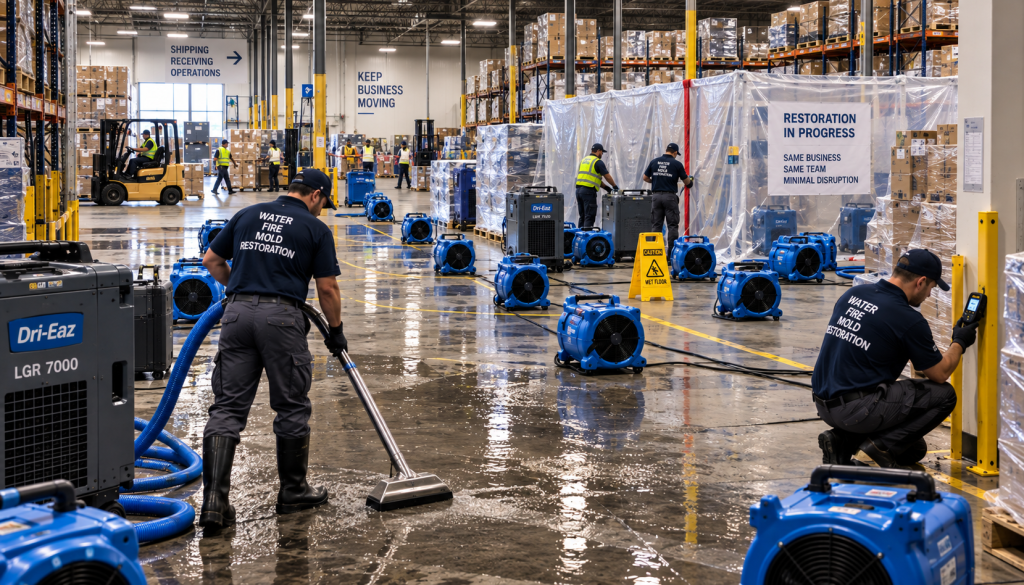
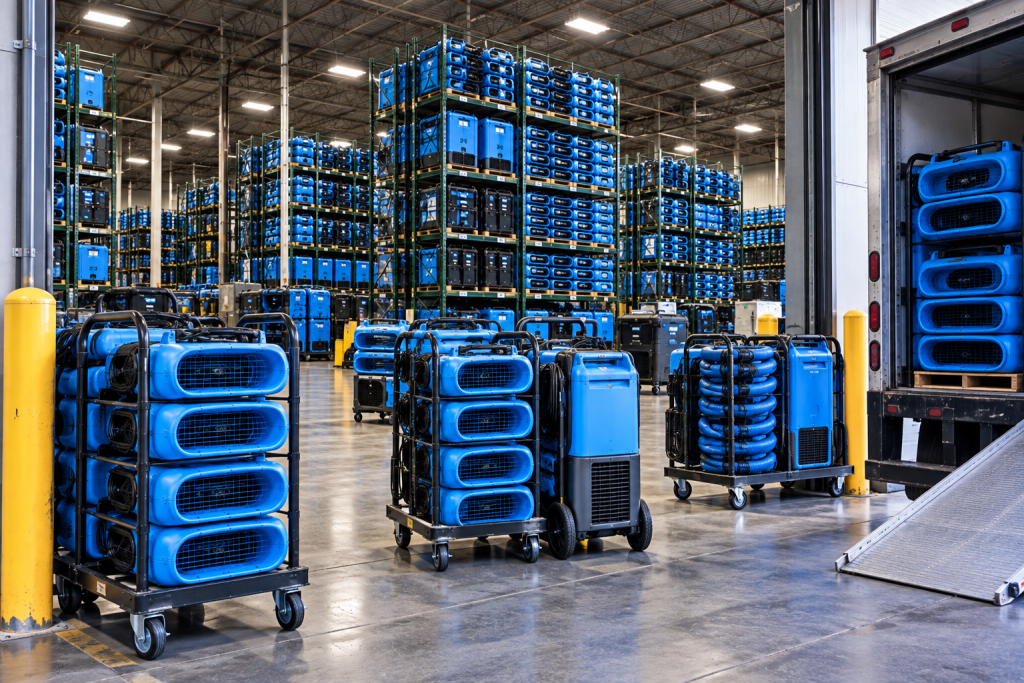
Warehouses can experience water spreading across enormous floor areas.
Hotels and multifamily buildings can have vertical water migration between rooms and floors.
Industrial properties may contain machinery, inventory and electrical systems that substantially change the restoration strategy.
Commercial restoration therefore requires both a building plan and an operational plan.
Office Water Damage
Office buildings contain extensive infrastructure above ceilings and inside walls.
A plumbing failure may affect several offices before becoming visible.
Water can damage carpet, drywall, ceiling systems, lighting, electrical components and interior finishes within the same loss.
Interior glass and door systems can also become part of reconstruction if surrounding framing or flooring requires major work.
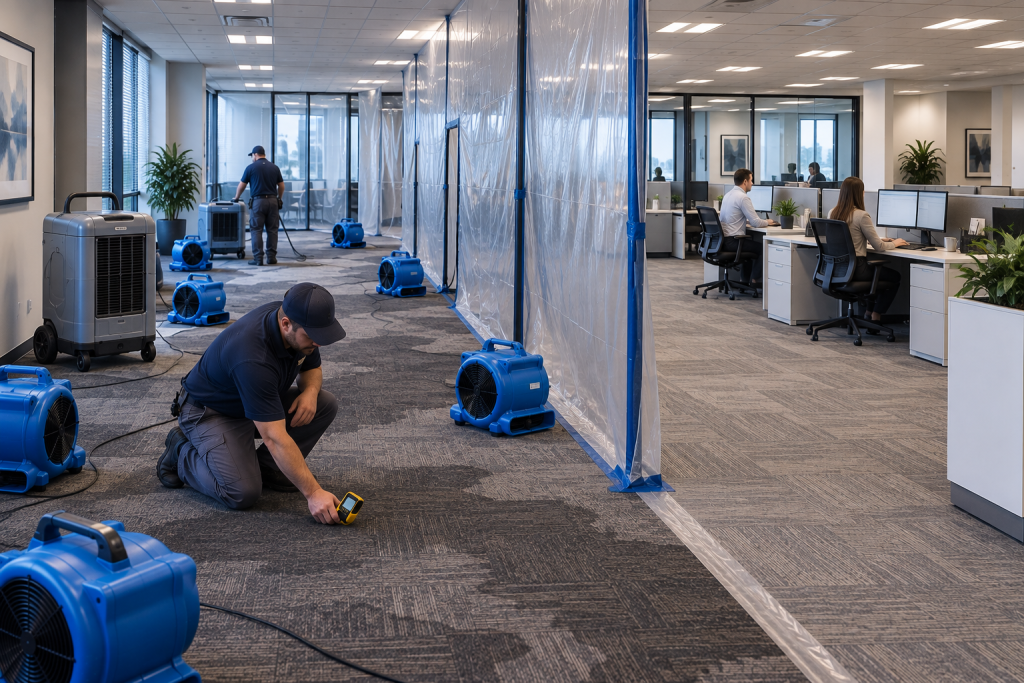
For occupied offices, phasing can become important.
Restoration areas may need to be separated from employees while unaffected portions of the workplace remain functional.
Retail & Restaurant Water Damage
Water damage in customer-facing businesses creates immediate operational pressure.
Retail properties may lose access to portions of the sales floor.
Restaurants can experience problems involving kitchens, dining areas, plumbing, flooring, electrical equipment and HVAC systems simultaneously.
Protecting unaffected areas becomes important.
Material staging, drying equipment and reconstruction activity should be planned around the property whenever conditions allow.
The goal is not simply drying the structure.
It is creating the shortest practical path toward returning the business to normal operation.
Warehouse & Industrial Water Damage
Warehouses and industrial buildings create a different scale of restoration.
Water may spread across large concrete floors and reach stored inventory, equipment or production areas.
Roof leaks can affect substantial sections of the building.
Fire sprinkler or plumbing failures may release large volumes of water quickly.
Electrical and mechanical infrastructure can be more extensive than in typical residential properties.
Restoration planning should account for how the facility operates and which areas need to return to service first.
Commercial Tenant Improvements After Water Damage
Major commercial water damage can overlap directly with tenant improvement construction.
Suppose an older office loses flooring, drywall and portions of its ceiling during a significant water loss.
Rebuilding the exact same outdated configuration only to remodel it later may duplicate demolition and construction.
Instead, the property owner can evaluate the future use of the space before build-back begins.
Conference rooms can be repositioned.
Interior glass may be introduced.
Electrical and data systems can be updated.
HVAC distribution can coordinate with the new layout.
Retail configurations may change.
New flooring can be selected around the future tenant.
The sequence can become:
Water mitigation → structural drying → damage assessment → tenant improvement planning → commercial build-back.
That creates an opportunity to restore the property while preparing it for its next use.
Remodeling After Residential Water Damage
The same principle can apply to homes.
A major water loss may require flooring, cabinets, drywall or ceilings to be removed regardless of whether remodeling was planned.
Homeowners can then decide whether recreating the previous room makes sense.
An older kitchen may be redesigned during reconstruction.
Bathrooms can receive updated finishes.
Flooring can change throughout connected areas.
Lighting and electrical improvements may be coordinated while walls and ceilings are already open.
Windows or doors approaching replacement may also be considered.
Restoration and remodeling are different objectives, but coordinating them can avoid rebuilding something that the homeowner intended to replace anyway.
Water Damage Reconstruction & Build-Back
Drying the property is only part of recovery.
Significant losses may eventually require:
- Flooring and subfloor repair
- Drywall
- Insulation
- Ceilings
- Painting
- Baseboards and trim
- Cabinetry
- Doors
- Windows and glass
- Plumbing
- Electrical work
- HVAC coordination
- Roofing repairs
- Commercial tenant improvements
- Residential remodeling
- Complete commercial build-outs
Planning reconstruction early can help create a smoother transition from mitigation to recovery.
Restore the Entire Property, Not Just the Wet Area
The most important thing to understand about water damage is how interconnected a building really is.
A plumbing problem can become a flooring, drywall, framing and electrical problem.
Roof damage can eventually involve insulation, ceilings, paint and interior walls.
Window intrusion can reach framing and floors.
Commercial flooding can simultaneously affect offices, HVAC, electrical infrastructure, inventory and tenant operations.
Visible water is only the beginning of the investigation.
Effective water damage restoration follows the loss through the property—from its original source to every material, system and space it reached.
For homes, that means considering the structure as a whole.
For businesses, it means considering both the building and the operation inside it.
From water extraction and structural drying through flooring, walls, ceilings, plumbing, electrical systems, HVAC, windows, roofing, painting and final reconstruction, the goal is not simply to make the property look dry again.
The goal is to understand what the water actually affected and restore the building accordingly.
For water damage restoration in San Diego, contact Superbest Water Damage Flood Repair San Diego at 619-693-1470.